CASE STUDY | When does a business deserve a valuation re-rating?

CASE STUDY | When does a business deserve a valuation re-rating?

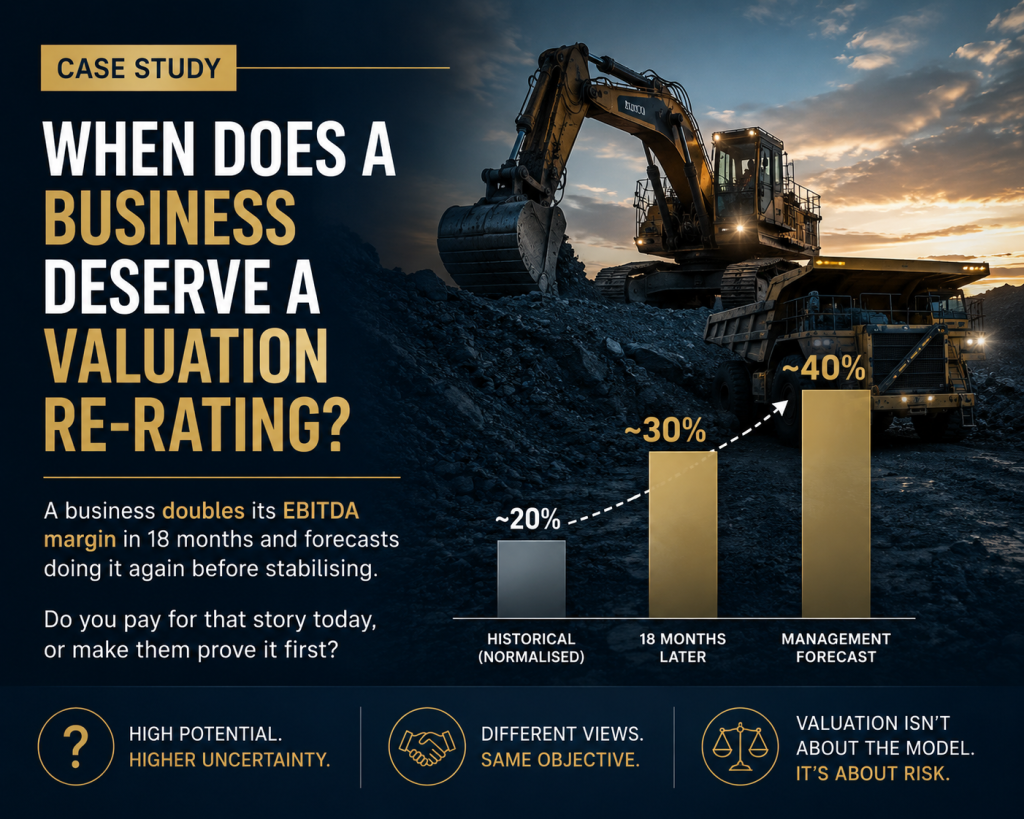
A business doubles its EBITDA margin in 18 months and forecasts doing it again before stabilising. Do you pay for that story today, or make them prove it first?

We recently advised on the valuation of a business supplying mission-critical equipment to the mining industry.

Over approximately 18 months, the company repositioned itself within the value chain. Rather than primarily sourcing completed equipment from third parties, it brought substantially more assembly, integration, customisation and installation capabilities in-house. In doing so, it captured a greater share of the value chain while delivering bespoke solutions tailored to customers’ operational requirements.

The financial impact was compelling:

  • Revenue grew steadily over the period.
  • Reported EBITDA margins increased from the low-to-mid teens to the low-to-mid 30s.
  • Management forecast a further step change, with significant revenue growth and EBITDA margins approaching 40% before stabilising, supported by a strong order pipeline and confidence in underlying demand.

This is where the valuation became particularly interesting. The challenge wasn’t determining what the business was worth today. It was determining how much value should be attributed to a future that management believed was highly probable, but which the buyer had yet to see demonstrated.

The seller believed the business had earned a valuation re-rating based on its new earnings profile. The buyer agreed the transformation was real, but questioned whether 18 months of evidence was sufficient to capitalise forecasts that assumed another material increase in both revenue and profitability.

As advisers, we explored several mechanisms to bridge the valuation gap, including earn-outs, deferred consideration and performance-based price adjustment mechanisms linked to future earnings. Each represented a rational way of allocating risk between buyer and seller.

Ultimately, however, the buyer wasn’t prepared to pay today for earnings that had yet to be realised, while the seller wasn’t willing to defer a meaningful portion of value for what it believed was already reflected in the business. The conclusion was simple: don’t debate the forecast, test it.

Allow another reporting cycle. If management delivered another year of strong growth and margins approaching the forecast, much of the valuation uncertainty would disappear.

In our experience, the most challenging valuations are rarely solved by selecting the right multiple or building the perfect DCF. They’re solved by appropriately allocating uncertainty between buyer and seller.

How would you have approached this transaction?

#BusinessValuation #CorporateFinance #MergersAndAcquisitions #KensingtonCapital

Why Strong Acquisition Opportunities Still Don’t Get Funded

What successful acquirers do differently in the South African mid-market

One of the most persistent misconceptions in acquisition finance is that a strong opportunity will naturally attract funding.

On the surface, that logic is compelling. If the target business is profitable, strategically attractive, cash-generative and well positioned in its market, it seems reasonable to assume lenders and investors would be eager to support the deal.

Yet, in practice, many attractive acquisitions never proceed.

Not because the target is weak, but because the acquirer is not sufficiently positioned to access the capital required to complete the transaction.

Funders back acquirers, not just acquisitions

Business owners and management teams often spend considerable time identifying attractive targets. They evaluate synergies, growth opportunities, market share gains and potential returns.

Funders, however, typically assess the transaction through a different lens. Before they underwrite the target business, most lenders want to understand the acquirer.

Questions commonly include:

  • How much capital is the buyer contributing?
  • How strong is the buyer’s balance sheet?
  • What security is available?
  • What is management’s acquisition and integration track record?
  • Can the borrower continue servicing debt under stressed conditions?

The distinction matters. While the quality of the target is important, lenders are ultimately assessing the party responsible for servicing and repaying the debt.

Across the South African mid-market, that distinction is still too often overlooked.

The “70:30 rule” is not a rule

Many prospective acquirers still approach the market assuming that acquisition finance follows a simple formula: 70% debt and 30% equity.

It can be a useful reference point, but it should never be mistaken for a dependable rule.

Debt capacity is influenced by cash flow stability, industry cyclicality, existing leverage, security availability, management capability and customer concentration risks.

In some transactions, lenders may support higher leverage. In others, materially lower debt levels are appropriate.  Acquisition finance structures are shaped by risk, not rules of thumb.

The more important question is often equity

Discussions about debt often overshadow a more fundamental question:

Where does the equity contribution come from?

For many owner-managed and mid-market businesses, the required equity is not readily available in retained earnings or sitting in excess cash reserves.  This is where otherwise attractive opportunities often stall.

A business may identify a compelling target and even secure lender interest, yet still be unable to proceed because it cannot meet the required equity contribution. This challenge creates a structural reality within the market.

Businesses with stronger balance sheets, retained earnings and existing capital resources are able to pursue opportunities that may be inaccessible to otherwise capable competitors.

Vendor funding and DFIs: valuable, but not complete solutions

Historically, vendor funding played an important role in bridging capital gaps.

While it remains highly relevant, lenders are increasingly cautious about structures that rely heavily on seller financing. They generally want to see genuine buyer risk capital beneath their debt position.

Similarly, Development Finance Institutions (DFIs) play an important role in supporting economic growth and transformation in South Africa.

However, many businesses mistakenly view DFI funding as a universal alternative when commercial funding proves difficult to access.  Approval processes can be extensive, timelines are often lengthy, and specific developmental mandates may need to be satisfied.

Where speed, certainty of execution and transaction flexibility matter, DFI funding may not always align with the realities of a private transaction.

Debt capital comes with operating consequences

When acquisition finance is discussed, many acquirers focus primarily on pricing.

While pricing matters, it is only one component of the funding package.

Acquisition debt frequently includes:

  • Financial covenants
  • Security requirements
  • Reporting obligations
  • Dividend restrictions
  • Limitations on additional borrowing
  • Restrictions on future acquisitions

Understanding these conditions is just as important as securing the debt itself.

Why larger businesses keep compounding their advantage

One of the defining characteristics of acquisition markets is that larger organisations are often able to pursue opportunities that smaller competitors simply cannot.

This is rarely because they identify better opportunities.

More often, they have spent years building the foundations required to access capital efficiently.

These foundations typically include:

  • Strong balance sheets
  • Meaningful cash reserves
  • Established banking relationships
  • Proven acquisition track records
  • Diversified earnings streams

This creates a powerful compounding effect. Capital enables acquisitions. Acquisitions strengthen earnings. Stronger earnings unlock additional capital.

Over time, that dynamic widens the gap between businesses that can act and those that remain constrained.

Improving acquisition funding readiness

While every transaction is different, businesses that consistently access acquisition capital tend to focus on long-term readiness rather than transaction-by-transaction improvisation.

In practice, that usually means:

Preserve balance sheet strength: Build and maintain capital reserves well in advance of a transaction.

Manage relationships proactively: Build relationships with lenders and investors before capital is actively required.

Improve operational visibility: Raise the quality of financial reporting, forecasting and cash flow visibility to institutional standards.

Clarify strategy: Develop a credible acquisition and integration roadmap that demonstrates management capability.

Successful capital raising is rarely about approaching the largest number of funders. It is about presenting a transaction with a realistic capital structure, a credible investment case and an alignment of risk between lenders, investors, vendors and management.

A simple readiness check:

Before pursuing a transaction, management teams should be able to answer four questions clearly: How much equity can we contribute? What level of debt can the business support under stress? What funding relationships are already in place? And do we have a credible integration plan?

How we support clients

At Kensington Capital, we work with shareholders, management teams and investors to assess funding readiness, evaluate appropriate capital structures, identify funding gaps, and support capital-raising processes through to execution.

More often, the challenge is not the absence of capital, but structuring a transaction in a way that aligns the interests and risk appetite of lenders, investors, vendors and management teams.

The difference between a successful funding outcome and an unsuccessful one is often not the quality of the opportunity itself, but the quality of the preparation, structuring and process behind it.

Final thought

The acquisition opportunity may surface in a matter of months. The ability to fund it is usually built over many years.

Successful acquirers understand that acquisition finance is not a reactive transaction event.

It is the outcome of deliberate balance sheet discipline, capital accumulation, relationship building and strategic preparation.

Ultimately, funders back acquirers, not just acquisitions.


Start a conversation with us today (https://www.kensingtoncapital.co.za/contact-us/)

Copyright Kensington Capital 2026

Valuation: The Cornerstone of Business Divestment and Investment

Valuation: The Cornerstone of Business Divestment and Investment

If you’re a private company business owner or shareholder and looking to ready the business for divestment, selling shares to partners, or putting it out into the market for private equity professional investment, or for internal accounting purposes… commissioning a sophisticated valuation is the starting point.

Valuation is the cornerstone of financial analysis, allowing one to assess the worth and true fair value of an asset or company.

Why sophisticated?

Too many people rely on a simple multiple based approach. Favourite multiples are EV/EBITDA (Enterprise Value to Earnings Before Interest and Depreciation & Amortisation) or P/E (price-to-earnings).

Multiples are great and useful for very specific purposes. It has some distinctive drawbacks.

Before we look at these handicaps, a brief overview.

EV/EBITDA is the classic multiple, referencing the EBITDA number and multiplying by the multiple to achieve the Enterprise Value (EV) – the total value of the business due to all debt and equity stakeholders. EBITDA as we know is the proxy for operating profits before non-cash depreciation.

The multiple is easy to understand, it is quick, and it compares well to industry or sector-based averages. Specific industries and companies of related maturities have relatively standardised multiples.

For instance, mining, manufacturing or industrial sectors will typically be bankable and primed for raising capital at an average of 3.0x to 3.5x, while FinTech and the technology sector is comfortably around 5.0x, and financial sector companies even higher at 7.0x to 8.0x.

The P/E (price-to-earnings) multiple references the price (market capitalisation or 100% marketable equity value) of the business against net profits. The market capitalsation is derived from the EV by adjusting for net debt.

Similarly, the P/E is relatively standard for various industries and sectors. The P/E multiple should always be higher than the EV/EBITDA, quite simply because the net profit component (denominator) is smaller than operating profit (accounting for debt repayments, taxes, and depreciation and barring other curiosities). The lower denominated increases the multiple.

Following the example above, the mining, manufacturing or industrial sectors will be matched to the above EV/EBITDA at an average P/E of 5.0x to 8.0x, while FinTech and technology sector is comfortably 10.5x, with Financial sector companies even higher at 15.0 to 16.0x.

Multiples are great when you are therefore looking for peer comparisons between companies in a specific sector, hence a market-based approach.

Drawbacks to multiples.

First, the multiple is historical based, it only represents the current static view and historic performance of the company.

Second, and perhaps most importantly, the multiple approach does not present a window into the working capital and capital investment (capex) cash flow movements.

The EV/EBITDA multiple specifically does not account for the business’ utilisation of debt and equity in its capital structure. A firm might be highly geared with high risky debt versus another company in the same sector (say direct competitors). While both companies have the same EBITDA, the actual fair value of these businesses are not the same.

The multiples are also too sensitive to accounting adjustments and methods employed by one firm over another – specifically with respect to non-operating expenses.

Gold standard DCF.

In contrast, and not to get too technical, the sophisticated DCF (discounted cash flow) methodology is a complex model that extrapolates the firms cash flows forward, adjusting for normalised earnings, accounting for the movements in working capital and capex, and importantly, incorporates the cost of capital and the time value of money – both fundamental in correctly unpacking and understanding the fair value of a firm.

The WACC (weighted cost of capital) built out explicitly for the company according to the CAPM (capital asset pricing model) is the rate employed to discount the future cash flows to a present value, and in so doing, allows one to consider the company specific factors, the timing and risk of the cash flows.

Drawback of the DCF income method is that it can become complex, and it requires careful consideration of the cost of capital (WACC) and the sensitive assumptions that drives the forecasted cash flows. The quality and integrity of the data is therefore very important.

The DCF provides an intrinsic value of the company, based on fundamentals. A comprehensive and flexible methodology.

In short, multiples must not be the primary valuation technique, instead its power sits as a reasonability check and comparison to the DCF fair value.

Towards the tail of the DCF.

Consider early growth stage companies, such as FinTech or technology business that are spending and developing their IP/technology, still rolling out their tech into the market for wider adoption. The cash flows are small compared to the development cost of the said IP/tech. In these special instances the DCF valuation of a business is likely to be negative, since their earnings is negative. The only way to show value is on the balance sheet via a Net Asset Value (NAV) approach by accounting for the actual development costs and other related expenses as a build-up of an intangible asset.

For most cases, whether insurance or annuity companies, manufacturing or mining, services or anything really – the ability to generate cash flow comes from the operating asset, which may be the actual human resources, the machinery, tools or assets utilised to offer goods or services.

Historical cash flows inform future cash flows in a stable business. The margins achieved informs the margins one can extrapolate into the future and specifically also informs potential growth scenarios.

The DCF methodology accounts for these nuances and scenarios.

In the example above of the negative equity value tech company, the value sits in the tail (in the future cash flows, 5y or 10y into the future).
In the DCF one accounts for this through the Terminal Value (TV), also discounted to present and added to the present value of the explicitly extrapolated cash flow. Combined, these values add up to the EV.

A base case, or a version of the business as-is today (as it operates today) can be extrapolated and approximated via projecting stable cash flows, with growth that is based on historically achieved average margins (excluding any shocks and pandemic style historical swings).

A management case in contrast will almost always be a more optimistic view of the future growth.

The reliance on the tail and the TV is a potential pitfall of the DCF, yet this is something we’ll delve into more in future articles.

Link to LinkedIn article