
CASE STUDY | When does a business deserve a valuation re-rating?
CASE STUDY | When does a business deserve a valuation re-rating?
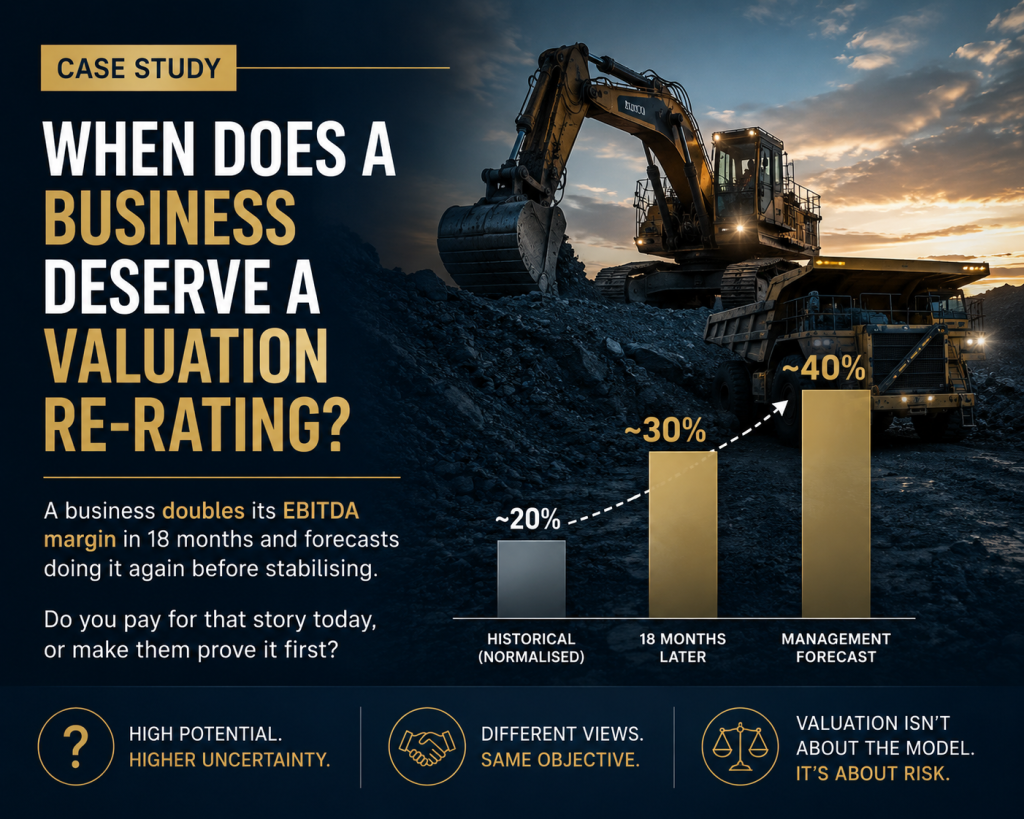
A business doubles its EBITDA margin in 18 months and forecasts doing it again before stabilising. Do you pay for that story today, or make them prove it first?
We recently advised on the valuation of a business supplying mission-critical equipment to the mining industry.
Over approximately 18 months, the company repositioned itself within the value chain. Rather than primarily sourcing completed equipment from third parties, it brought substantially more assembly, integration, customisation and installation capabilities in-house. In doing so, it captured a greater share of the value chain while delivering bespoke solutions tailored to customers’ operational requirements.
The financial impact was compelling:
- Revenue grew steadily over the period.
- Reported EBITDA margins increased from the low-to-mid teens to the low-to-mid 30s.
- Management forecast a further step change, with significant revenue growth and EBITDA margins approaching 40% before stabilising, supported by a strong order pipeline and confidence in underlying demand.
This is where the valuation became particularly interesting. The challenge wasn’t determining what the business was worth today. It was determining how much value should be attributed to a future that management believed was highly probable, but which the buyer had yet to see demonstrated.
The seller believed the business had earned a valuation re-rating based on its new earnings profile. The buyer agreed the transformation was real, but questioned whether 18 months of evidence was sufficient to capitalise forecasts that assumed another material increase in both revenue and profitability.
As advisers, we explored several mechanisms to bridge the valuation gap, including earn-outs, deferred consideration and performance-based price adjustment mechanisms linked to future earnings. Each represented a rational way of allocating risk between buyer and seller.
Ultimately, however, the buyer wasn’t prepared to pay today for earnings that had yet to be realised, while the seller wasn’t willing to defer a meaningful portion of value for what it believed was already reflected in the business. The conclusion was simple: don’t debate the forecast, test it.
Allow another reporting cycle. If management delivered another year of strong growth and margins approaching the forecast, much of the valuation uncertainty would disappear.
In our experience, the most challenging valuations are rarely solved by selecting the right multiple or building the perfect DCF. They’re solved by appropriately allocating uncertainty between buyer and seller.
How would you have approached this transaction?
#BusinessValuation #CorporateFinance #MergersAndAcquisitions #KensingtonCapital

Leave a Reply
Want to join the discussion?Feel free to contribute!